
Introduction: The Pharmaceutical Industry at a Digital Inflection Point
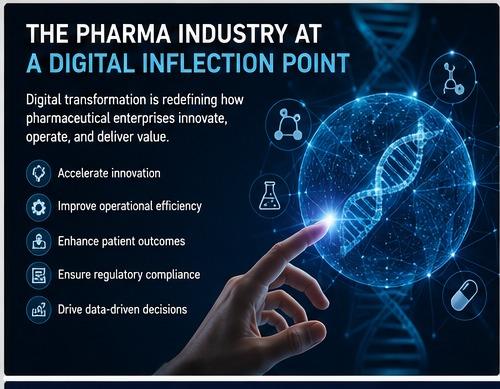
The pharmaceutical industry is experiencing one of the most significant technological shifts in its history. For decades, pharma organizations relied on fragmented workflows, siloed datasets, paper-heavy documentation, disconnected laboratory systems, and legacy infrastructures that slowed innovation and increased operational complexity. Today, however, the rise of Artificial Intelligence (AI), cloud computing, scientific informatics, automation, and data interoperability frameworks is fundamentally redefining how pharmaceutical enterprises operate. Digital transformation is no longer limited to implementing isolated software tools—it has evolved into a holistic, end-to-end enterprise modernization strategy that spans the entire pharmaceutical value chain. From drug discovery and clinical development to manufacturing, regulatory compliance, pharmacovigilance, and commercial operations, digital transformation is enabling pharma companies to become more predictive, data-driven, agile, and patient-centric.
Organizations that successfully embrace this transformation are not just improving efficiency—they are building the foundation for the next generation of scientific innovation.
What Does End-to-End Digital Transformation Really Mean in Pharma?
End-to-end digital transformation refers to the integration of digital technologies, intelligent automation, connected data ecosystems, and advanced analytics across all operational and scientific functions within a pharmaceutical enterprise. This transformation involves modernizing legacy systems, creating interoperable data infrastructures, automating repetitive scientific workflows, enabling AI-powered decision-making, integrating cloud-native research environments, and building scalable digital laboratories and manufacturing ecosystems. The objective is not simply digitization—it is the creation of an intelligent pharmaceutical enterprise where data flows seamlessly across departments, systems, instruments, and stakeholders.
The Traditional Challenges Slowing Pharmaceutical Innovation
Despite scientific advancements, many pharma organizations still struggle with operational bottlenecks caused by fragmented digital ecosystems.
1. Data Silos Across Departments
Research, clinical operations, quality assurance, manufacturing, and regulatory affairs often operate on disconnected platforms. This results in redundant workflows, limited data visibility, poor interoperability, and delayed decision-making. Critical scientific insights frequently remain trapped inside isolated systems.
2. Legacy Infrastructure Limitations
Many pharmaceutical companies continue to rely on outdated architectures that were not designed for high-throughput analytics, AI integration, real-time data processing, cloud scalability, or advanced automation. Legacy systems significantly reduce organizational agility.
3. Regulatory Complexity
The pharmaceutical sector operates within highly regulated environments requiring auditability, traceability, data integrity, and compliance with GxP, FDA, EMA, and 21 CFR Part 11 standards. Manual compliance processes increase both operational risk and administrative burden.
4. Fragmented Scientific Workflows
Modern laboratories generate massive amounts of multidimensional experimental data through chromatography, spectroscopy, genomics, bioinformatics, high-content imaging, and omics technologies. Without standardized informatics frameworks, extracting value from this data becomes extremely difficult.
The Core Pillars of Digital Transformation in Pharma
1. Scientific Informatics and Data Standardization
Scientific informatics forms the backbone of modern pharmaceutical digital ecosystems. Organizations are increasingly adopting Laboratory Information Management Systems (LIMS), Electronic Lab Notebooks (ELNs), knowledge graphs, ontology-driven data architectures, and FAIR data principles. Standardized data models ensure interoperability between instruments, software platforms, and enterprise systems. Frameworks such as Allotrope, CDISC, HL7, and FHIR are becoming essential for enabling semantic consistency and machine-readable scientific workflows. This allows organizations to build connected research ecosystems where data becomes reusable, contextualized, and AI-ready.
2. Artificial Intelligence and Predictive Analytics
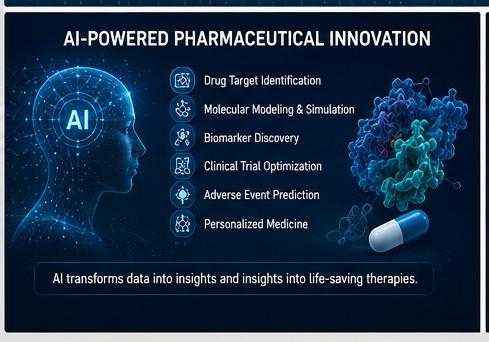
AI is becoming one of the most transformative forces in pharmaceutical innovation. Modern pharma companies are leveraging Machine Learning (ML), Deep Learning, Natural Language Processing (NLP), predictive modeling, and Generative AI to accelerate drug target identification, molecular modeling, biomarker discovery, clinical trial optimization, adverse event prediction, and personalized medicine strategies. AI-driven systems reduce research timelines while improving accuracy and scalability. However, AI effectiveness depends heavily on the availability of clean, structured, interoperable datasets. This is why data governance and digital infrastructure are foundational components of transformation.
3. Cloud-Native Pharmaceutical Ecosystems
Cloud computing is enabling pharma companies to transition from static infrastructures to scalable digital platforms. Cloud-native environments support real-time collaboration, high-performance computing, secure data sharing, scalable analytics pipelines, and multi-site integration. This is particularly critical for global pharmaceutical enterprises operating across distributed R&D centers and manufacturing facilities. Cloud transformation also enhances disaster recovery, cybersecurity resilience, and infrastructure flexibility.
4. Smart Manufacturing and Industry 4.0
Digital transformation extends far beyond research laboratories. Modern pharmaceutical manufacturing is increasingly driven by Industrial IoT (IIoT), digital twins, robotics, predictive maintenance, automated quality control, and real-time process monitoring. Through Industry 4.0 technologies, manufacturers can optimize yield efficiency, batch consistency, supply chain visibility, and production scalability. This creates highly adaptive manufacturing ecosystems capable of responding dynamically to operational changes.
5. Automation and Workflow Orchestration
Pharma companies are aggressively automating repetitive workflows to improve efficiency and reduce human error. Automation now powers data ingestion pipelines, laboratory workflows, clinical documentation, regulatory submissions, pharmacovigilance reporting, and quality management systems. Workflow orchestration platforms integrate these functions into centralized ecosystems, creating seamless operational continuity across departments.
The Rise of the Connected Digital Laboratory
Despite scientific advancements, many pharma organizations still struggle with operational bottlenecks caused by fragmented digital ecosystems. Research, clinical operations, quality assurance, manufacturing, and regulatory affairs often operate on disconnected platforms. This results in redundant workflows, limited data visibility, poor interoperability, and delayed decision-making. Critical scientific insights frequently remain trapped inside isolated systems. Many pharmaceutical companies continue to rely on outdated architectures that were not designed for high-throughput analytics, AI integration, real-time data processing, cloud scalability, or advanced automation. Legacy systems significantly reduce organizational agility.
The pharmaceutical sector operates within highly regulated environments requiring auditability, traceability, data integrity, and compliance with GxP, FDA, EMA, and 21 CFR Part 11 standards. Manual compliance processes increase both operational risk and administrative burden.Modern laboratories generate massive amounts of multidimensional experimental data through chromatography, spectroscopy, genomics, bioinformatics, high-content imaging, and omics technologies. Without standardized informatics frameworks, extracting value from this data becomes extremely difficult.
Scientific informatics forms the backbone of modern pharmaceutical digital ecosystems. Organizations are increasingly adopting Laboratory Information Management Systems (LIMS), Electronic Lab Notebooks (ELNs), knowledge graphs, ontology-driven data architectures, and FAIR data principles. Standardized data models ensure interoperability between instruments, software platforms, and enterprise systems. Frameworks such as Allotrope, CDISC, HL7, and FHIR are becoming essential for enabling semantic consistency and machine-readable scientific workflows. This allows organizations to build connected research ecosystems where data becomes reusable, contextualized, and AI-ready.
AI is becoming one of the most transformative forces in pharmaceutical innovation. Modern pharma companies are leveraging Machine Learning (ML), Deep Learning, Natural Language Processing (NLP), predictive modeling, and Generative AI to accelerate drug target identification, molecular modeling, biomarker discovery, clinical trial optimization, adverse event prediction, and personalized medicine strategies. AI-driven systems reduce research timelines while improving accuracy and scalability. However, AI effectiveness depends heavily on the availability of clean, structured, interoperable datasets. This is why data governance and digital infrastructure are foundational components of transformation.
Cloud computing is enabling pharma companies to transition from static infrastructures to scalable digital platforms. Cloud-native environments support real-time collaboration, high-performance computing, secure data sharing, scalable analytics pipelines, and multi-site integration. This is particularly critical for global pharmaceutical enterprises operating across distributed R&D centers and manufacturing facilities. Cloud transformation also enhances disaster recovery, cybersecurity resilience, and infrastructure flexibility.
Digital transformation extends far beyond research laboratories. Modern pharmaceutical manufacturing is increasingly driven by Industrial IoT (IIoT), digital twins, robotics, predictive maintenance, automated quality control, and real-time process monitoring. Through Industry 4.0 technologies, manufacturers can optimize yield efficiency, batch consistency, supply chain visibility, and production scalability. This creates highly adaptive manufacturing ecosystems capable of responding dynamically to operational changes.
Pharma companies are aggressively automating repetitive workflows to improve efficiency and reduce human error. Automation now powers data ingestion pipelines, laboratory workflows, clinical documentation, regulatory submissions, pharmacovigilance reporting, and quality management systems. Workflow orchestration platforms integrate these functions into centralized ecosystems, creating seamless operational continuity across departments.
Cybersecurity and Data Governance: Critical Priorities
As pharma companies digitize operations, cybersecurity becomes increasingly important. Sensitive scientific and patient data must be protected through zero-trust architectures, encryption frameworks, identity access management, secure cloud environments, and continuous threat monitoring.
Simultaneously, robust data governance policies ensure data lineage, version control, metadata management, regulatory compliance, and ethical AI deployment. Without governance, digital transformation can introduce significant operational and compliance risks.
Business Impact of End-to-End Digital Transformation
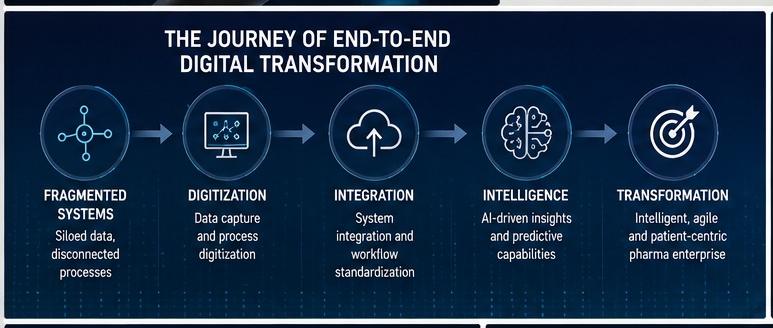
Pharmaceutical organizations implementing comprehensive digital strategies are experiencing measurable benefits. AI-powered analytics dramatically reduce target identification and lead optimization timelines, accelerating drug discovery. Automation minimizes manual intervention and increases throughput, leading to improved operational efficiency. Digital traceability improves audit readiness and reporting accuracy, enhancing regulatory compliance. Cloud ecosystems enable seamless collaboration across research sites worldwide, supporting scalable global collaboration. Interoperable systems unlock previously inaccessible scientific insights, resulting in higher data utilization. Integrated digital pipelines reduce development bottlenecks across the product lifecycle, enabling a faster time-to-market.
The Human Element: Why Transformation Is More Than Technology
True digital transformation is not just a technological upgrade—it is also a cultural transformation. Organizations must invest in upskilling scientific teams, building cross-functional collaboration, encouraging data literacy, and promoting digital-first thinking. Scientists, informaticians, engineers, data architects, and AI specialists must work together within a unified innovation framework. The most successful pharma companies are those combining advanced technology with human expertise and scientific creativity.
The Future of Pharma Is Intelligent, Connected, and Predictive
The pharmaceutical industry is rapidly transitioning toward a future defined by autonomous laboratories, AI-augmented research, real-time clinical intelligence, precision medicine ecosystems, hyperconnected manufacturing networks, and semantic scientific data infrastructures. In this new paradigm, data becomes more than an operational asset—it becomes the foundation of competitive advantage and scientific discovery.
Conclusion
End-to-end digital transformation is no longer optional for pharmaceutical organizations—it is essential for long-term innovation, scalability, and resilience.
By integrating AI, scientific informatics, automation, cloud computing, interoperable data standards, and connected digital infrastructures, pharma companies can fundamentally transform how therapies are discovered, developed, manufactured, and delivered. The future belongs to organizations capable of turning fragmented scientific workflows into intelligent, connected ecosystems powered by data-driven decision-making.
Digital transformation is not simply modernizing pharma—it is redefining the future of life sciences itself.