
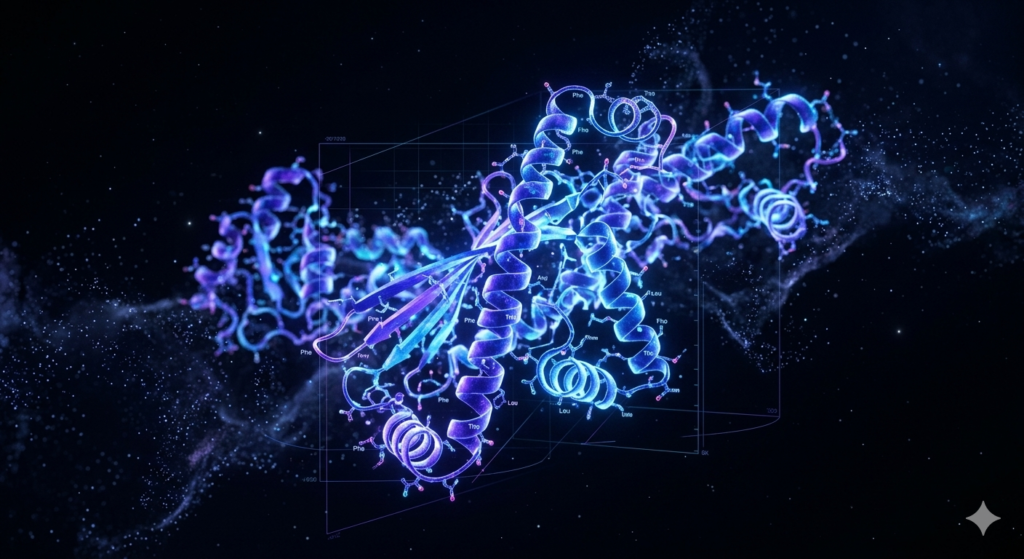
How Google DeepMind’s AI Breakthrough Is Reshaping Biology — and What It Means for the Future of Medicine.
Introduction
Proteins are the building blocks of life. Their 3D structure determines their function — and understanding that structure is the foundation of modern drug discovery. For decades, mapping a single protein structure could take years and cost millions. AlphaFold changed that overnight.
The Problem It Solved
Over 200 million proteins are now known to science. Traditional methods — X-ray crystallography, cryo-EM — are powerful but slow, expensive, and impossible to scale. The gap between what we know and what we can act on was enormous.
AlphaFold closed that gap.
What Makes AlphaFold a Breakthrough?
Developed by Google DeepMind, AlphaFold uses deep learning to predict protein structures from amino acid sequences — with near-experimental accuracy, in minutes.
Its key capabilities:
- Predicts novel structures without templates
- Processes millions of proteins at scale
- Includes built-in confidence scoring
- AlphaFold3 now extends to DNA, RNA, and ligand interactions
Its performance at CASP14 — the global protein structure prediction benchmark — marked a turning point that the scientific community described as a once-in-a-generation leap.
Real-World Impact
The numbers speak for themselves:
- 200+ million protein structures predicted
- 3+ million researchers across 190+ countries supported
- Open access via the AlphaFold database — democratising structural biology globally
- Millions saved in research costs and time
AlphaFold in Drug Discovery
In structure-based drug discovery, AlphaFold is enabling:
- Faster identification of therapeutic targets
- Deeper protein-ligand interaction studies
- Accelerated early-stage drug development
That said, AlphaFold models can underperform in high-throughput docking compared to experimentally derived structures. Post-model refinement and experimental validation remain essential. The most effective approach today is hybrid AI + experimental — using AlphaFold to guide, not replace, the lab.
What’s Next
The road ahead includes better modelling of dynamic protein behaviour, improved docking compatibility, and deeper integration with end-to-end drug discovery pipelines. As these capabilities mature, AlphaFold will move from a research accelerator to a core pillar of precision medicine.
Conclusion
AlphaFold didn’t just improve protein prediction — it redefined what’s possible. For life science organizations, integrating AI-driven structural biology tools is no longer a future consideration. It is a competitive necessity. At Texium Solutions, we help pharma and biotech companies harness AI-driven innovations — from bioinformatics to healthcare analytics — to stay ahead of the curve.
Want to explore how AI tools like AlphaFold can accelerate your drug discovery or research workflows?
👉 Connect with Texium Solutions today.