
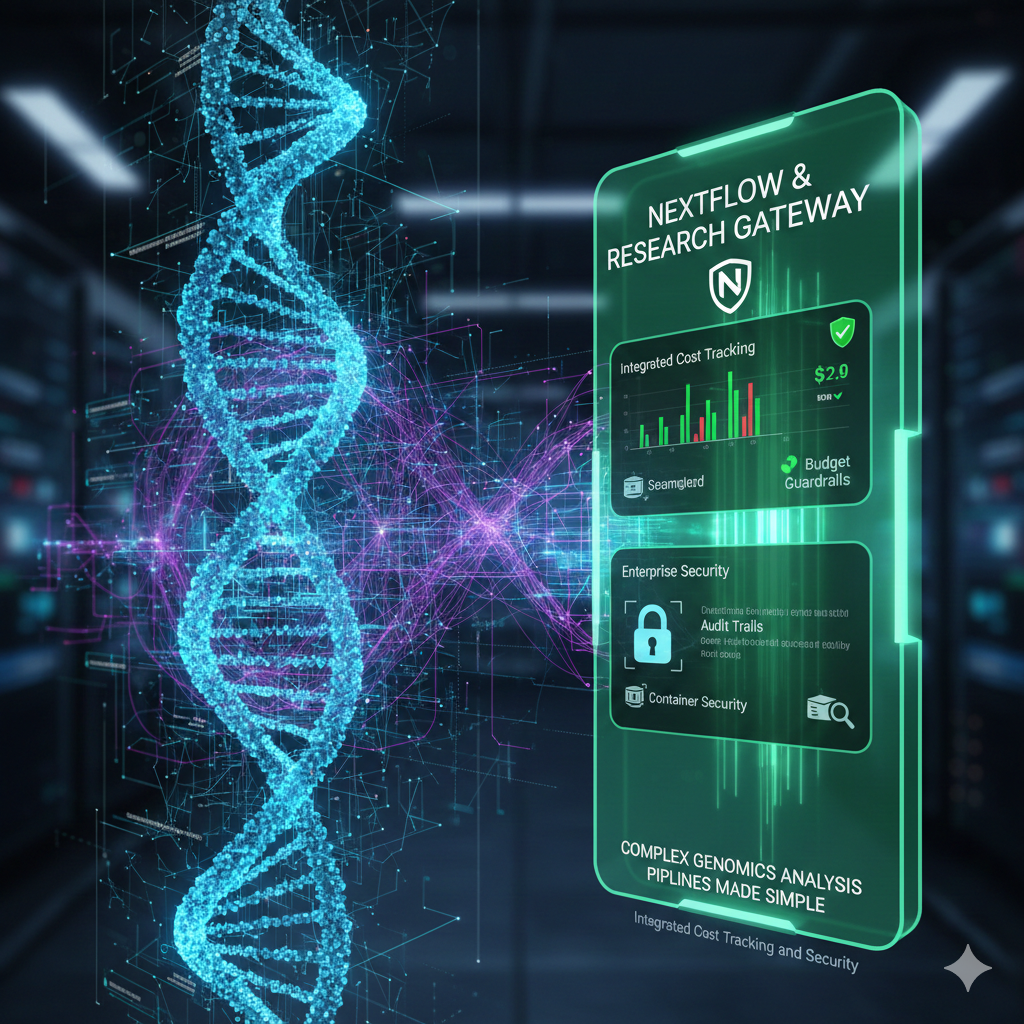
Complex Genomics Analysis Pipelines Made Simple with Nextflow & Research Gateway: Integrated Cost Tracking and Security
Transforming genomic research with scalable, secure, and cost-effective workflow orchestration
Introduction
The genomics landscape has evolved dramatically over the past decade. What once took years and millions of dollars to sequence a single human genome now takes hours and costs under $1,000. However, this exponential growth in sequencing capacity has created a new challenge: managing the computational complexity of analyzing massive genomic datasets.
Enter Nextflow and Research Gateway — a powerful combination that transforms complex genomics analysis pipelines into streamlined, reproducible, and cost-effective workflows while maintaining enterprise-grade security.
The Challenge: Complexity in Genomics Pipelines
Modern genomics research involves intricate multi-step pipelines that can include:
- Quality control and preprocessing of raw sequencing reads
- Alignment to reference genomes
- Variant calling to identify genetic mutations
- Annotation to understand biological significance
- Statistical analysis and visualization
- Integration with clinical and phenotypic data
Each step requires specialized bioinformatics tools, substantial computational resources, and careful data management. Research teams often struggle with:
- Pipeline complexity: Managing dependencies between dozens of tools and steps
- Reproducibility issues: Ensuring analyses can be replicated across different environments
- Resource optimization: Balancing speed, cost, and computational efficiency
- Data security: Protecting sensitive patient genomic information
- Cost visibility: Understanding and controlling cloud computing expenses
- Scalability: Processing hundreds or thousands of samples efficiently
The Solution: Nextflow + Research Gateway Architecture
What is Nextflow?
Nextflow is a powerful workflow orchestration framework designed specifically for data-intensive computational pipelines. It enables:
- Portable workflows that run seamlessly across local clusters, cloud platforms, and HPC systems
- Automatic parallelization to maximize resource utilization
- Container integration with Docker and Singularity for reproducibility
- Resume capability to restart failed jobs without reprocessing completed steps
- Native cloud support for AWS, Google Cloud, and Azure
What is Research Gateway?
Research Gateway provides a secure, user-friendly web portal that abstracts the complexity of high-performance computing infrastructure. It offers:
- Self-service interface for researchers without command-line expertise
- Job submission and monitoring through intuitive dashboards
- Resource allocation management with customizable compute profiles
- Integration with institutional authentication (LDAP, SSO, OAuth)
- Audit trails for compliance and reproducibility
The Integrated Architecture
The combined Nextflow and Research Gateway solution creates a comprehensive genomics analysis platform:
┌─────────────────────────────────────────────────────┐
│           Research Gateway Web Portal               │
│  (Authentication, Job Submission, Monitoring)       │
└────────────────────┬────────────────────────────────┘
                     │
┌────────────────────┴────────────────────────────────┐
│         Nextflow Orchestration Layer                │
│  (Workflow Management, Task Distribution)           │
└────────────────────┬────────────────────────────────┘
                     │
     ┌───────────────┼───────────────┐
     │               │               │
┌────┴────┐    ┌────┴────┐    ┌────┴────┐
│   AWS   │    │  Azure  │    │   GCP   │
│ Batch   │    │  Batch  │    │  Life   │
└─────────┘    └─────────┘    └─────────┘
     │               │               │
┌────┴───────────────┴───────────────┴────┐
│     Shared Storage (S3, Blob, GCS)      │
└──────────────────────────────────────────┘
Key Features and Benefits
1. Simplified Pipeline Development
Nextflow’s domain-specific language (DSL) makes pipeline development intuitive:
process alignReads {
    container 'biocontainers/bwa:0.7.17'

    input:
    tuple val(sample_id), path(reads)
    path reference

    output:
    tuple val(sample_id), path("${sample_id}.bam")

    script:
    """
    bwa mem -t ${task.cpus} ${reference} ${reads} |
    samtools sort -o ${sample_id}.bam
    """
}
This clear, declarative syntax allows researchers to focus on scientific logic rather than infrastructure complexity.
2. Integrated Cost Tracking
One of the most critical features for research organizations is comprehensive cost visibility:
Real-time Cost Monitoring
- Track compute costs per pipeline, per sample, and per user
- Monitor storage costs across different tiers and regions
- Visualize spending trends and patterns over time
Budget Management
- Set spending limits for projects and research groups
- Receive alerts when approaching budget thresholds
- Automatic job termination options for budget overruns
Cost Optimization
- Spot instance integration for 70–90% cost savings on interruptible workloads
- Automatic resource right-sizing based on historical usage
- Intelligent data lifecycle management (hot/warm/cold storage tiers)
Detailed Cost Attribution
- Granular tagging: project, grant, PI, department
- Chargeback reports for institutional accounting
- Cost-per-sample metrics for grant applications
3. Enterprise-Grade Security
Genomic data is highly sensitive, requiring robust security measures:
Data Protection
- Encryption at rest using AES-256
- Encryption in transit with TLS 1.3
- Key management through AWS KMS, Azure Key Vault, or Google Cloud KMS
- Automated data retention and deletion policies
Access Control
- Role-based access control (RBAC) with fine-grained permissions
- Integration with institutional identity providers (Shibboleth, SAML, OAuth2)
- Multi-factor authentication (MFA) enforcement
- Session management and timeout policies
Compliance & Auditing
- HIPAA, GDPR, and FISMA compliance frameworks
- Comprehensive audit logs for all data access and modifications
- Automated compliance reporting
- Data residency controls for international regulations
Network Security
- Private VPC deployment with isolated subnets
- Security group and firewall rules
- VPN or Direct Connect for on-premises integration
- DDoS protection and WAF integration
4. Reproducibility and Versioning
Scientific reproducibility is paramount:
- Pipeline versioning: Git integration tracks every change to workflow code
- Container snapshots: Immutable Docker/Singularity images ensure tool consistency
- Parameter tracking: Every job execution logs complete parameter sets
- Environment capture: Nextflow records exact compute environments
- Results provenance: Complete lineage from raw data to final outputs
5. Scalability and Performance
Handle projects of any size:
- Automatic scaling: Dynamically provision resources based on workload
- Parallel execution: Process hundreds of samples simultaneously
- Resume capability: Restart failed pipelines without reprocessing
- Caching: Reuse intermediate results across pipeline runs
- Multi-cloud: Distribute workloads across providers for optimal performance
Real-World Use Cases
Case Study 1: Cancer Genomics Research
A major cancer research institute processes 500 whole genome sequences per month:
Before Implementation:
- Manual job submission taking 2–3 hours per batch
- Inconsistent tool versions causing reproducibility issues
- Limited cost visibility leading to $50,000 monthly overruns
- Security audit findings requiring remediation
After Implementation:
- One-click pipeline submission through Research Gateway
- 100% reproducible analyses with containerized workflows
- 35% cost reduction through spot instances and optimization
- Full HIPAA compliance with comprehensive audit trails
- Processing time reduced from 48 hours to 18 hours per genome
Impact: The research team increased throughput by 200% while reducing costs by $210,000 annually.
Case Study 2: Population Genomics Study
An international consortium analyzing 10,000 genomes across multiple sites:
Challenges:
- Multi-site collaboration with varying compute infrastructure
- Data sovereignty requirements (EU data must stay in EU)
- Budget constraints requiring cost optimization
- Need for standardized analysis protocols
Solution:
- Nextflow pipelines deployed identically across AWS (US), Azure (EU), and on-premises HPC
- Research Gateway providing unified interface for all sites
- Geo-fenced data storage with automated compliance
- Real-time cost tracking allocated by contributing institution
Results:
- Seamless collaboration across 15 institutions
- 100% protocol standardization ensuring comparable results
- 42% cost savings through intelligent resource allocation
- Zero compliance violations over 18-month study
Case Study 3: Clinical Genomics Laboratory
A clinical diagnostics lab processing patient samples for rare disease diagnosis:
Requirements:
- CAP/CLIA compliance for clinical reporting
- Turnaround time under 14 days
- Complete audit trail for every analysis
- Cost per sample under $300
Implementation:
- Validated Nextflow pipelines with locked tool versions
- Research Gateway with clinical-grade access controls
- Automated quality control and flagging
- Integration with LIMS for sample tracking
Outcomes:
- Average turnaround reduced to 8 days
- Cost per sample: $245 (18% under target)
- Passed CAP inspection with zero findings
- 99.7% first-pass success rate
Implementation Guide
Step 1: Infrastructure Setup
Cloud Environment Preparation
# AWS Setup
- VPC with private subnets
- S3 buckets with versioning and encryption
- AWS Batch compute environments
- IAM roles and policies
- CloudWatch logging
# Azure Setup
- Virtual Network with service endpoints
- Azure Blob Storage with lifecycle management
- Azure Batch pools
- Azure Active Directory integration
- Azure Monitor configuration
Step 2: Research Gateway Deployment
# Deploy Research Gateway on Kubernetes
kubectl create namespace research-gateway
kubectl apply -f research-gateway-deployment.yaml
# Configure authentication
- Connect to institutional LDAP/AD
- Set up OAuth2 with institutional IdP
- Configure MFA requirements
Step 3: Nextflow Pipeline Configuration
// nextflow.config
profiles {
    aws {
        process.executor = 'awsbatch'
        process.queue = 'genomics-queue'
        aws.region = 'us-east-1'
        aws.batch.cliPath = '/usr/local/bin/aws'
    }

    azure {
        process.executor = 'azurebatch'
        azure.batch.accountName = 'genomics-batch'
        azure.storage.accountName = 'genomicsstorage'
    }
}
// Cost tracking tags
process {
    tags = [
        project: params.project_id,
        pi: params.principal_investigator,
        grant: params.grant_number
    ]
}
Step 4: Cost Tracking Integration
# Cost tracking configuration
cost_tracking:
  enabled: true
  providers:
    - aws_cost_explorer
    - azure_cost_management

  alerts:
    - type: budget_threshold
      threshold: 0.80
      action: notify
      recipients: ["pi@institution.edu"]

    - type: budget_exceeded
      threshold: 1.00
      action: suspend_jobs

  reporting:
    frequency: weekly
    granularity: per_project
Step 5: Security Hardening
# Security configuration
security:
  encryption:
    at_rest: AES256
    in_transit: TLS1.3
    key_management: aws_kms

  access_control:
    authentication: saml_sso
    mfa_required: true
    session_timeout: 3600

  compliance:
    frameworks: [HIPAA, GDPR]
    audit_logging: enabled
    data_retention: 7_years

  network:
    vpc_isolation: true
    private_endpoints: true
    allowed_ip_ranges: ["10.0.0.0/8"]
Best Practices
Pipeline Development
- Modularize workflows: Break pipelines into reusable processes
- Use containers: Ensure reproducibility with Docker/Singularity
- Version control: Store pipelines in Git repositories
- Document parameters: Provide clear documentation for all inputs
- Test thoroughly: Validate on small datasets before production runs
Cost Optimization
- Use spot instances: Leverage preemptible VMs for 70–90% savings
- Right-size resources: Match compute to actual requirements
- Implement caching: Reuse results when possible
- Data lifecycle: Move cold data to cheaper storage tiers
- Monitor continuously: Set up alerts for cost anomalies
Security Management
- Principle of least privilege: Grant minimum necessary permissions
- Regular audits: Review access logs and permissions quarterly
- Encrypt everything: Use encryption for all data states
- Patch management: Keep all software up to date
- Incident response: Have a documented security incident plan
Operational Excellence
- Automate testing: CI/CD for pipeline validation
- Monitor performance: Track execution times and resource usage
- Capacity planning: Forecast resource needs based on growth
- Documentation: Maintain runbooks and troubleshooting guides
- Training: Invest in user education and onboarding
Technical Architecture Deep Dive
Nextflow Tower Integration
Nextflow Tower (now Seqera Platform) provides enterprise features:
┌─────────────────────────────────────────┐
│        Research Gateway UI              │
└────────────────┬────────────────────────┘
                 │
┌────────────────┴────────────────────────┐
│       Nextflow Tower/Seqera            │
│  - Workflow Management                  │
│  - Monitoring & Logging                 │
│  - Resource Optimization                │
└────────────────┬────────────────────────┘
                 │
┌────────────────┴────────────────────────┐
│     Compute Environments                │
│  - AWS Batch                            │
│  - Azure Batch                          │
│  - Google Life Sciences                 │
│  - Kubernetes                           │
│  - HPC (Slurm, PBS, LSF)               │
└─────────────────────────────────────────┘
Data Flow Architecture
Raw FASTQ Files (S3/Blob)
          ↓
    Quality Control
          ↓
   Read Alignment (BWA/Bowtie)
          ↓
    BAM Processing
          ↓
  Variant Calling (GATK)
          ↓
    Annotation (VEP)
          ↓
   Results Database
          ↓
  Visualization Dashboard
Monitoring and Observability
Comprehensive monitoring stack:
- Nextflow Metrics: Task completion, resource usage, failure rates
- Infrastructure Metrics: CPU, memory, network, disk I/O
- Cost Metrics: Spend by project, user, resource type
- Security Events: Login attempts, access violations, data exports
- Performance Metrics: Pipeline duration, throughput, bottlenecks
Integration Ecosystem
The platform integrates with:
- LIMS Systems: LabVantage, STARLIMS, Benchling
- Data Management: iRODS, Globus, Aspera
- Analysis Tools: Galaxy, UCSC Genome Browser, IGV
- Collaboration: Slack, Teams, email notifications
- Version Control: GitHub, GitLab, Bitbucket
ROI Analysis
Cost Breakdown
Traditional HPC Approach:
- Capital expense: $500,000 (hardware)
- Annual maintenance: $75,000
- Personnel (2 FTEs): $200,000/year
- Power and cooling: $30,000/year
- Total 5-year cost: $2,025,000
Cloud-Native Nextflow/Research Gateway:
- Implementation: $50,000 (one-time)
- Cloud compute: $120,000/year
- Storage: $20,000/year
- Platform licensing: $15,000/year
- Personnel (0.5 FTE): $50,000/year
- Total 5-year cost: $1,075,000
Savings: $950,000 over 5 years (47% reduction)
Productivity Gains
- Pipeline development time: Reduced by 60%
- Analysis turnaround: Reduced by 40%
- Researcher self-service: 80% of jobs submitted without IT support
- Failed job debugging: Reduced by 70% with better error tracking
- Reproducibility: 100% (vs. 65% with manual processes)
Future Roadmap
The genomics analysis landscape continues to evolve:
Emerging Technologies
- Long-read sequencing: PacBio HiFi and Oxford Nanopore integration
- Spatial transcriptomics: New pipeline modules for spatial data
- Single-cell analysis: Optimized workflows for scRNA-seq
- AI/ML integration: Automated quality control and variant interpretation
Platform Enhancements
- Multi-omics integration: Combine genomics, transcriptomics, proteomics
- Real-time analysis: Streaming pipelines for nanopore sequencing
- Federated learning: Privacy-preserving multi-site collaboration
- Advanced cost prediction: ML-based cost forecasting
Regulatory Evolution
- Clinical genomics: Enhanced validation and quality management
- Data sharing: GA4GH standards implementation
- International compliance: GDPR, HIPAA, regional regulations
- Ethical AI: Bias detection and fairness monitoring
Conclusion
The combination of Nextflow and Research Gateway represents a paradigm shift in genomics analysis infrastructure. By providing a platform that simultaneously addresses technical complexity, cost management, and security requirements, research organizations can focus on scientific discovery rather than infrastructure challenges.
Key takeaways:
- Simplicity at scale: Complex pipelines become manageable through workflow orchestration
- Cost transparency: Real-time tracking and optimization reduce cloud expenses by 30–50%
- Security first: Enterprise-grade controls protect sensitive genomic data
- Reproducibility: Container-based workflows ensure consistent, verifiable results
- Flexibility: Support for multiple cloud providers and on-premises infrastructure
As genomic sequencing continues to accelerate, the need for robust, scalable, and cost-effective analysis infrastructure will only grow. Organizations that adopt modern workflow orchestration platforms position themselves at the forefront of genomics research, enabling discoveries that were previously impossible due to computational limitations.
The future of genomics is not just about generating more data — it’s about deriving meaningful insights from that data efficiently, securely, and economically. Nextflow and Research Gateway provide the foundation for that future.
Resources
Documentation
Training
- Nextflow Training Workshops
- AWS Genomics Workflows
- Azure Genomics Best Practices
- Google Cloud Life Sciences
Community
- Nextflow Slack Channel
- nf-core Community Forum
- Bioinformatics Stack Exchange
- Cloud Genomics Working Group
Getting Started
Ready to transform your genomics analysis infrastructure? Contact your cloud provider or visit the Nextflow and Research Gateway websites to begin your journey toward simplified, secure, and cost-effective genomics pipelines.
