
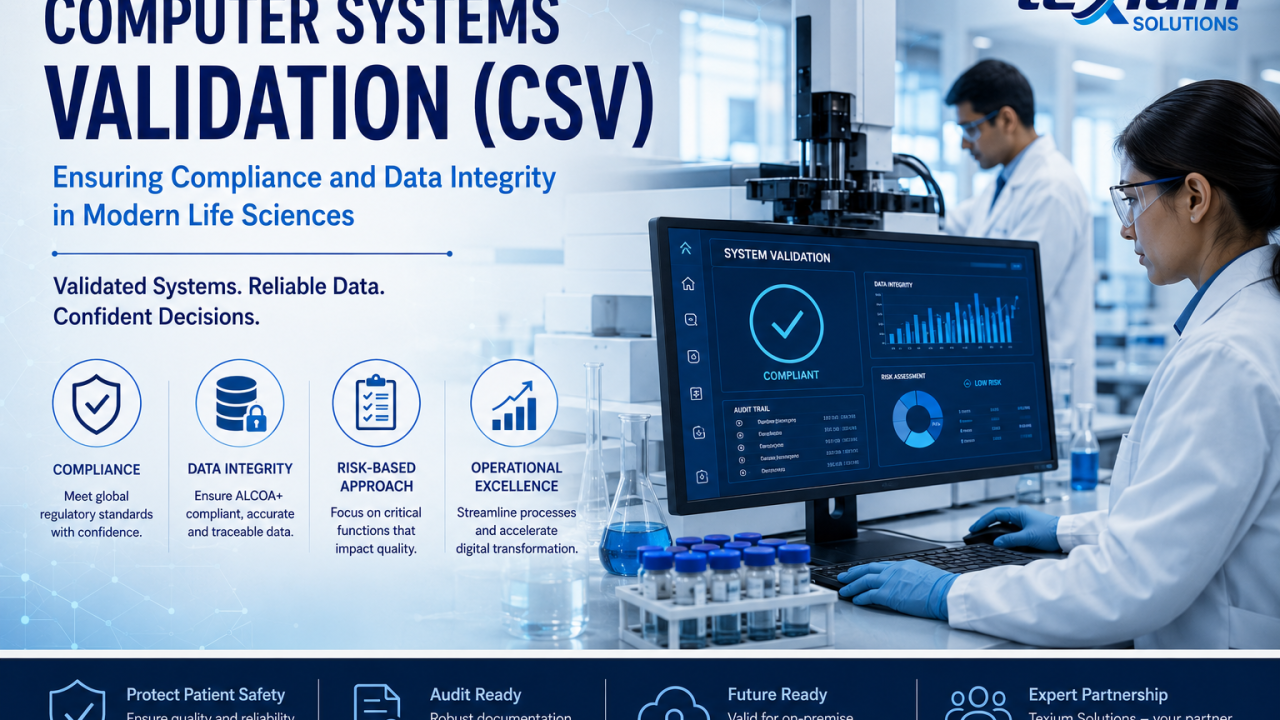
Introduction
The life sciences industry is undergoing a profound digital transformation. Laboratories that once relied on paper records, spreadsheets, and disconnected software are rapidly adopting Laboratory Information Management Systems (LIMS), Electronic Laboratory Notebooks (ELNs), Chromatography Data Systems (CDS), Manufacturing Execution Systems (MES), cloud platforms, and advanced analytics solutions. These technologies are helping organizations improve productivity, accelerate research, and generate high-quality scientific data. However, as laboratories become increasingly digital, ensuring that computerized systems consistently perform as intended has become more important than ever.
In regulated industries such as pharmaceuticals, biotechnology, medical devices, and clinical research, computerized systems directly influence product quality, patient safety, and regulatory compliance. Even a minor system failure, configuration error, or data integrity issue can lead to inaccurate results, delayed product releases, costly investigations, or regulatory observations. This is why Computer Systems Validation (CSV) has become a fundamental requirement for organizations operating in regulated environments.
Rather than viewing CSV as simply another compliance obligation, organizations should recognize it as a strategic process that builds confidence in laboratory operations. A well-executed validation program ensures that technology supports scientific innovation while maintaining the integrity, reliability, and traceability of critical data throughout its lifecycle.
What is Computer Systems Validation?

Computer Systems Validation is a documented process that provides objective evidence that a computerized system consistently performs according to its intended purpose while meeting regulatory and business requirements. Validation extends far beyond software testing. It encompasses planning, risk assessment, requirement gathering, system configuration, testing, documentation, user acceptance, change management, and continuous monitoring throughout the system’s operational life.
Every computerized system used in regulated activities has the potential to impact product quality or patient safety. Whether the system manages laboratory samples, records analytical results, controls manufacturing equipment, or stores clinical data, organizations must demonstrate that it operates reliably under normal business conditions. Validation provides this assurance by establishing confidence that systems are fit for their intended use and continue to perform consistently as business needs evolve.
Unlike one-time implementation projects, Computer Systems Validation is an ongoing lifecycle activity. Software updates, infrastructure changes, new integrations, and evolving regulatory requirements all require organizations to periodically evaluate whether validated systems continue to operate in a compliant state.
Why Computer Systems Validation Matters
The growing reliance on digital technologies has significantly increased the importance of reliable computerized systems. Modern laboratories generate enormous volumes of scientific data every day, and this information forms the foundation for research decisions, quality control activities, manufacturing operations, and regulatory submissions. If this data cannot be trusted, neither can the decisions made from it.
Computer Systems Validation helps organizations minimize operational risks by ensuring that software functions correctly, records remain accurate, and electronic data can be traced throughout its lifecycle. It also strengthens confidence among regulators, customers, and business partners by demonstrating that quality systems are built upon validated and controlled technology.
Beyond regulatory compliance, effective validation delivers measurable business value. Well-validated systems reduce operational disruptions, improve process consistency, simplify audits, support faster software deployments, and decrease the likelihood of costly remediation projects. Organizations that integrate validation into their digital transformation initiatives often experience smoother implementations and greater user confidence in their technology investments.
The Regulatory Foundation of CSV

Life sciences organizations operate within highly regulated environments where data integrity and system reliability are essential. Regulatory agencies worldwide expect computerized systems supporting regulated activities to be validated before they are placed into production.
In the United States, FDA 21 CFR Part 11 establishes requirements for electronic records and electronic signatures, ensuring that digital information is trustworthy, reliable, and equivalent to traditional paper documentation. Similarly, international regulations such as EU GMP Annex 11 provide guidance on the use of computerized systems within pharmaceutical manufacturing and quality operations. Industry best practices, including GAMP 5, encourage organizations to adopt a risk-based approach to validation, allowing resources to be focused on functions that have the greatest impact on product quality and patient safety.
Although regulations differ across regions, they share a common objective: organizations must demonstrate that computerized systems are controlled, reliable, secure, and capable of consistently producing accurate results.
The Computer System Validation Lifecycle
Successful validation begins long before software is installed and continues throughout the operational life of the system. The process typically starts with understanding business objectives and identifying how the computerized system will support laboratory or manufacturing activities. During the planning stage, organizations define validation strategies, assign responsibilities, identify regulatory requirements, and perform initial risk assessments.
Once planning is complete, detailed user requirements are documented to ensure that the selected system aligns with both business needs and regulatory expectations. These requirements serve as the foundation for system configuration, implementation, and testing. After installation, organizations verify that hardware and software components have been deployed correctly before evaluating whether the system performs every required function accurately under real operating conditions.
Testing activities confirm that workflows, calculations, security controls, electronic signatures, audit trails, reports, and integrations perform as expected. Upon successful completion, validation documentation demonstrates that the system is suitable for production use. However, validation does not end after implementation. Ongoing activities such as change control, periodic review, backup verification, disaster recovery testing, and system upgrades help ensure that compliance is maintained throughout the system’s lifecycle.
From Traditional Validation to Risk-Based Validation
Modern validation practices have evolved considerably over the past decade. Traditional Computer Systems Validation often emphasized extensive documentation, lengthy approval cycles, and exhaustive testing of every system function regardless of its business impact. While this approach established strong documentation practices, it frequently delayed technology implementations and consumed significant organizational resources.
Today, regulatory authorities encourage organizations to adopt a more practical, risk-based approach. Instead of applying the same level of testing to every software feature, organizations are encouraged to focus validation efforts on functions that directly affect product quality, patient safety, and data integrity. Lower-risk features may require less extensive documentation, allowing validation teams to concentrate resources where they create the greatest value.
This shift enables laboratories to implement new technologies more efficiently while maintaining regulatory compliance. By combining critical thinking with risk assessment, organizations can streamline validation activities without compromising system reliability or scientific integrity.
Data Integrity: The Core of Every Validation Program

Reliable scientific decisions depend on reliable data. For this reason, data integrity remains one of the most important objectives of Computer Systems Validation. Every laboratory result, quality record, manufacturing parameter, or clinical observation must accurately represent the activity that produced it.
The widely accepted ALCOA+ principles provide the foundation for maintaining trustworthy electronic records. Information should be attributable to the individual who generated it, legible throughout its retention period, recorded at the time the activity occurred, preserved in its original form where appropriate, and maintained accurately without unauthorized modification. In addition, organizations should ensure that data remains complete, consistent, enduring, and readily available whenever required.
Modern laboratory systems support these principles through features such as secure user authentication, role-based access controls, audit trails, automated time stamps, electronic signatures, backup procedures, and version-controlled documentation. Together, these controls help create an environment where scientific information remains reliable, transparent, and fully traceable.
Validating Modern Digital Laboratories
Today’s laboratories rarely rely on a single application. Instead, they operate within interconnected digital ecosystems where multiple platforms exchange information continuously. Laboratory Information Management Systems, Electronic Laboratory Notebooks, analytical instruments, enterprise resource planning systems, manufacturing platforms, cloud applications, and business intelligence tools all contribute to the flow of scientific data.
As these systems become increasingly integrated, validation must extend beyond individual applications to include interfaces, automated workflows, data transfers, and system interoperability. Organizations should verify that information moves accurately between platforms without loss, duplication, or unauthorized modification. This holistic approach helps maintain data integrity while supporting efficient laboratory operations.
Cloud computing has introduced additional considerations, including vendor qualification, cybersecurity, service availability, infrastructure updates, and shared responsibility models. Organizations must evaluate not only their own internal controls but also the quality management practices of software providers to ensure that cloud-based solutions continue to meet regulatory expectations.
Best Practices for an Effective CSV Program

A successful Computer Systems Validation program combines regulatory knowledge, technical expertise, and sound project management. Organizations should begin every validation project with a thorough risk assessment to identify critical business processes and prioritize validation activities accordingly. Clear documentation of user requirements helps ensure that systems are configured to meet both operational and compliance objectives.
Cross-functional collaboration between laboratory personnel, quality assurance teams, information technology specialists, and validation professionals is equally important. Each stakeholder contributes unique expertise that helps identify potential risks and ensures that systems support real-world scientific workflows.
Organizations should also establish robust change management procedures to evaluate the impact of software updates, infrastructure modifications, and configuration changes before implementation. Regular training, periodic reviews, internal audits, and continuous monitoring further strengthen long-term compliance and reduce the likelihood of unexpected regulatory observations.
How Texium Solutions Supports Computer Systems Validation

At Texium Solutions, we understand that successful validation requires more than producing documentation. It requires combining scientific knowledge, regulatory understanding, and technology expertise to create systems that are reliable, efficient, and future-ready.
Our team helps life sciences organizations implement and validate laboratory informatics solutions while ensuring alignment with global regulatory expectations. From requirements gathering and risk assessments to validation planning, system implementation, integration, testing, and ongoing support, we work closely with organizations to develop practical validation strategies that support both compliance and operational excellence.
Whether implementing a new LIMS, modernizing legacy laboratory applications, integrating enterprise systems, or adopting cloud-based technologies, our goal is to help organizations accelerate digital transformation while maintaining confidence in their computerized systems.
Conclusion
Computer Systems Validation has evolved from a documentation-driven regulatory exercise into a strategic business capability that supports quality, innovation, and digital transformation across the life sciences industry. As laboratories continue to adopt advanced technologies, organizations must ensure that computerized systems remain reliable, secure, and capable of producing trustworthy scientific data.
By embracing risk-based validation practices, maintaining strong data integrity controls, and integrating validation throughout the technology lifecycle, organizations can strengthen compliance while improving operational efficiency. Rather than slowing innovation, a mature validation program enables laboratories to adopt new technologies with confidence, ensuring that every digital investment contributes to better science, improved quality, and enhanced patient outcomes.
As the future of life sciences becomes increasingly connected, data-driven, and intelligent, Computer Systems Validation will remain one of the most important foundations for building trusted digital laboratories.