
Introduction
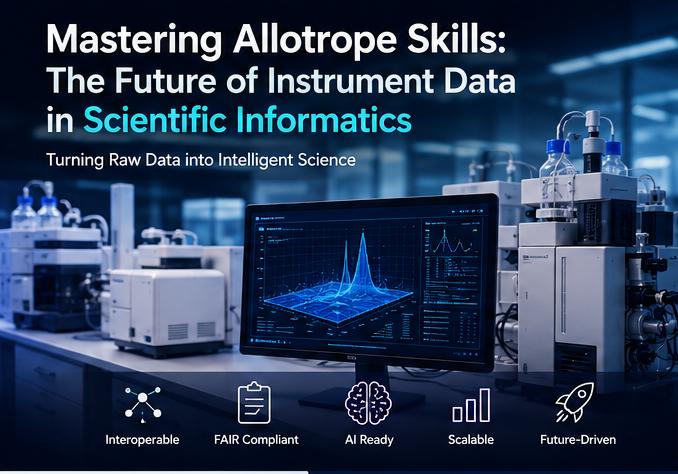
The life sciences industry is entering an era where data is becoming more valuable than the instruments generating it. Modern laboratories are powered by advanced analytical technologies—chromatography systems, mass spectrometers, spectroscopy platforms, and high-throughput sequencing instruments. But despite technological progress, one major problem continues to slow scientific innovation: instrument data fragmentation. Every instrument often produces data in its own proprietary format, creating disconnected ecosystems that are difficult to integrate, analyze, and scale. This is exactly why professionals with expertise in Allotrope standards and scientific data interoperability are becoming increasingly important across pharmaceutical, biotech, and AI-driven research organizations
What Is Allotrope and Why Does It Matter?
The Allotrope Foundation was created to solve one of the most persistent challenges in life sciences: How do we make scientific data universally understandable across instruments, software systems, and organizations? Its framework establishes a standardized, machine-readable architecture for laboratory data management, enabling seamless interoperability between analytical instruments and digital platforms. At its core, the Allotrope ecosystem includes ADF (Allotrope Data Format) for storing structured experimental data, ADM (Allotrope Data Models) for defining schema consistency, and AFO (Allotrope Foundation Ontologies) for semantic standardization. Together, these technologies create a FAIR-compliant data infrastructure—making scientific information Findable, Accessible, Interoperable, and Reusable.
Why Allotrope Skills Are Becoming Industry-Critical
Scientific organizations are rapidly transitioning toward AI-driven research workflows, digital laboratory ecosystems, automated analytical pipelines, and cloud-native scientific platforms. However, none of these systems can function efficiently without clean, contextualized, and standardized data. This is where Allotrope expertise becomes highly valuable. Professionals skilled in Allotrope frameworks help organizations eliminate data silos by enabling different instruments to communicate through standardized data structures instead of isolated proprietary formats. They improve AI readiness because machine learning systems perform better when trained on semantically enriched and standardized datasets. They also accelerate scientific decision-making by creating structured data pipelines that reduce manual intervention and improve analytical speed. Additionally, they enhance regulatory compliance, as standardized metadata improves traceability, reproducibility, and audit readiness.
The growing role of instrument informatics is transforming how scientific organizations operate. Scientific instruments are no longer standalone hardware systems. They are now part of a much larger ecosystem involving Laboratory Information Management Systems (LIMS), Electronic Lab Notebooks (ELNs), AI/ML analytics engines, cloud-based research infrastructures, and digital twin environments.
As this ecosystem expands, instrument informatics professionals must understand data harmonization, ontology mapping, metadata structuring, API-driven integration, and scientific workflow automation. Allotrope provides the foundational framework connecting these components into a unified digital architecture.
ADF and ASM: Turning Raw Instrument Outputs into Intelligent Data
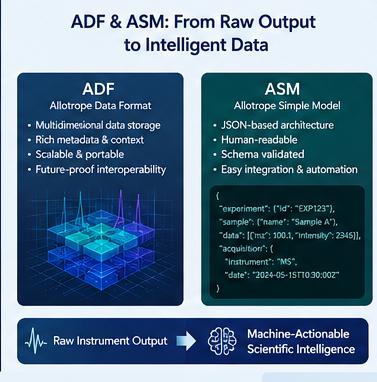
One of the most transformative aspects of the Allotrope ecosystem is its ability to convert raw experimental outputs into machine-actionable scientific intelligence.
ADF (Allotrope Data Format) enables the storage of multidimensional scientific data, integration of metadata and experimental context, scalable handling of high-volume analytical outputs, and long-term data portability and interoperability. This ensures that data generated today remains reusable for future AI and analytical applications.
ASM (Allotrope Simple Model) simplifies complex scientific datasets into a more accessible structure. Built using JSON-based architecture, ASM allows human-readable experimental representation, machine validation using standardized schemas, simplified integration across software platforms, and faster downstream analytics and automation. The result is a bridge between scientific complexity and computational usability.
AI and Allotrope: A Powerful Convergence
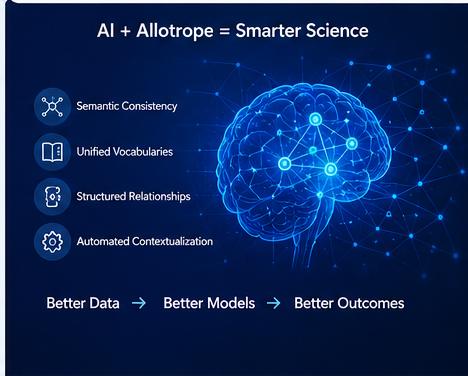
Artificial Intelligence is transforming drug discovery, genomics, biomarker research, and precision medicine. But AI systems require one critical ingredient: high-quality standardized data. Without structured data, AI pipelines suffer from poor model accuracy, inconsistent outputs, low reproducibility, and bias in training datasets. Allotrope helps solve this by enabling semantic consistency, unified scientific vocabularies, structured experimental relationships, and automated contextualization of datasets. This creates a robust foundation for scalable AI deployment in life sciences.
Career Opportunities Around Allotrope Expertise
As laboratories evolve into digitally connected ecosystems, demand is growing for professionals who understand scientific informatics, data engineering in life sciences, laboratory automation, instrument integration, ontology-driven data governance, and AI-ready scientific infrastructure. Organizations across pharma, biotech, CROs, and healthcare technology sectors are actively investing in these capabilities.
Professionals with Allotrope-related expertise are increasingly contributing to:
. Digital lab transformation Enterprise scientific data management
.AI-driven R&D platforms
. Cloud laboratory modernization
. Advanced analytical workflow integration
The Future of Scientific Data Is Interoperable
The future laboratory will not operate as isolated instruments connected through spreadsheets and manual workflows. Instead, it will function as a fully integrated digital ecosystem, where instruments communicate seamlessly, data flows automatically across platforms, AI systems generate real-time insights, experiments become reproducible at scale, and scientific knowledge becomes machine-readable. Allotrope is helping make this transition possible.
Conclusion
Scientific innovation is no longer limited by experimental capability—it is limited by how effectively organizations can structure, interpret, and operationalize their data. Mastering Allotrope-related skills means understanding the future of scientific interoperability, AI-powered research, digital laboratory ecosystems, and intelligent scientific informatics.
As life sciences continue to converge with AI and cloud technologies, standardized frameworks like Allotrope will become essential for transforming raw laboratory outputs into actionable scientific intelligence. The industry is moving from simple data collection toward connected, semantic, and intelligent science—and Allotrope sits at the center of that transformation.