
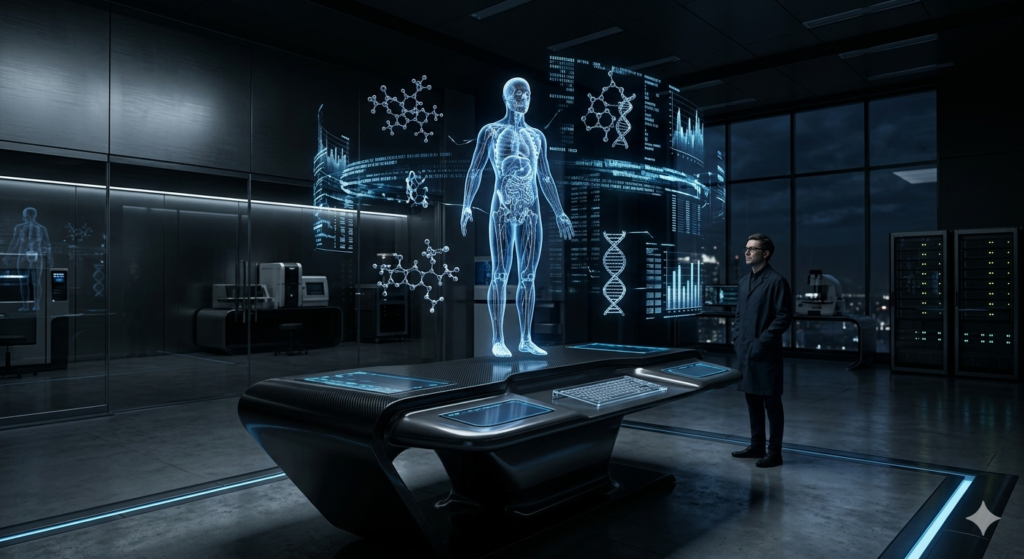
How Artificial Intelligence Is Reshaping the Future of Medicine — From Early Detection to the Lab Bench
Introduction
For decades, bringing a new drug to market has followed a familiar and grueling path: 10 to 15 years of development, over a billion dollars in investment, and a failure rate exceeding 90% in clinical trials. Meanwhile, diagnostic errors affect millions of patients annually, often with life-altering consequences. Artificial intelligence is changing both equations — and fast. From detecting cancer in radiology scans with greater accuracy than trained physicians to designing novel drug molecules in days rather than years, AI is no longer a future possibility in healthcare. It is an active, transformative force reshaping how diseases are identified, understood, and treated.
This blog explores how AI is revolutionizing diagnosis and drug development — and what it means for the life sciences industry.
Part 1: AI in Diagnosis
1. Medical Imaging and Radiology
One of the most mature applications of AI in healthcare is in medical imaging. Deep learning models — trained on millions of labelled scans — can now detect anomalies in X-rays, MRIs, CT scans, and pathology slides with remarkable precision. Google DeepMind’s AI system, for instance, has demonstrated the ability to detect over 50 eye diseases from retinal scans with accuracy matching world-leading specialists. Similar breakthroughs have been reported in mammography, lung cancer screening, and skin lesion classification.
The value isn’t just in accuracy — it’s in speed and scale. AI can analyse thousands of images in the time it takes a radiologist to review a handful, enabling earlier detection at population scale.
2. Predictive Diagnostics and Risk Stratification
Beyond imaging, AI is being applied to electronic health records (EHRs), genomic data, and wearable device outputs to predict disease before symptoms emerge. Predictive models are now being used to identify patients at high risk of sepsis, heart failure, diabetic complications, and even certain cancers — enabling clinicians to intervene earlier, when outcomes are significantly better.
In oncology, AI-powered liquid biopsy tools can detect circulating tumor DNA in blood samples, catching cancers at Stage I rather than Stage IV — a distinction that can mean the difference between cure and palliative care.
3. Pathology and Genomics
AI is transforming pathology by automating the analysis of tissue samples and identifying tumour subtypes with a level of granularity that human analysis cannot match at scale. Coupled with genomic profiling, this enables truly personalized treatment recommendations — matching the right therapy to the right patient based on their unique biological fingerprint.
Part 2: AI in Drug Development
4. Target Identification and Validation
The drug discovery process begins with identifying a biological target — a protein, gene, or pathway implicated in a disease. Traditionally, this process relies on years of laboratory research and serendipitous discovery. AI is accelerating this phase dramatically. By analysing vast datasets — genomic databases, scientific literature, protein interaction networks, and clinical trial results — AI models can identify novel targets that human researchers might take years to uncover or might miss entirely.
Companies like Recursion Pharmaceuticals and BenevolentAI are already using AI-driven target discovery to build robust pipelines across multiple disease areas simultaneously.
5. Protein Structure Prediction and Molecular Design
Perhaps the most celebrated AI breakthrough in life sciences is AlphaFold — DeepMind’s protein structure prediction model that solved a 50-year-old scientific challenge. By predicting the 3D structure of proteins from their amino acid sequences with near-experimental accuracy, AlphaFold has unlocked a new era of structure-based drug design.
Building on this, generative AI models are now being used to design entirely new drug molecules from scratch — optimised for potency, selectivity, and safety profiles before a single experiment is run in the lab.
6. Clinical Trial Optimization
Clinical trials are the most expensive and time-consuming phase of drug development. AI is transforming this stage in multiple ways: Patient recruitment — AI models can rapidly identify eligible patients from EHR databases, dramatically reducing the time to enroll and improving diversity in trial populations.Trial design — Adaptive trial designs powered by AI can modify study parameters in real time based on emerging data, improving efficiency and reducing unnecessary patient exposure to ineffective treatments.
Failure prediction — AI can analyse early-stage trial signals to predict which compounds are likely to fail, enabling earlier termination and reallocation of resources.
7. Drug Repurposing
Not every breakthrough requires discovering something new. AI is proving highly effective at identifying existing approved drugs that may be effective against new indications — a process called drug repurposing.
During the COVID-19 pandemic, AI platforms scanned existing drug libraries in days to identify candidates for testing — a process that would have taken years through conventional methods. The same approach is now being applied to rare diseases, antibiotic resistance, and neurodegenerative conditions.
Challenges and Considerations
Despite its enormous promise, AI in healthcare is not without challenges:
Data quality and bias — AI models are only as good as the data they are trained on. Biased or incomplete datasets can lead to models that perform poorly across diverse patient populations.
Regulatory frameworks — Regulators like the FDA are actively developing frameworks for AI-based medical devices and drug discovery tools, but the field is evolving faster than policy.
Explainability — Many deep learning models operate as “black boxes,” making it difficult for clinicians and regulators to understand how a decision was reached — a critical concern in high-stakes medical contexts.
Human-AI collaboration — The most effective implementations of AI in healthcare are those where human expertise and AI capabilities are genuinely integrated, not where one simply replaces the other.
The Road Ahead
The convergence of AI, genomics, real-world evidence, and digital health is creating an entirely new paradigm for medicine — one where diseases are caught earlier, treatments are personalised, and drug development timelines are measured in months rather than decades. For life science organisations, the question is no longer whether to embrace AI, but how fast and how strategically.
Those who invest early in AI-ready data infrastructure, talent, and partnerships will be the ones leading the next generation of medical breakthroughs.
Conclusion
AI is not replacing doctors or scientists — it is amplifying their capabilities in ways that were unimaginable even a decade ago. From the radiology suite to the chemistry lab, from clinical trials to the patient’s bedside, artificial intelligence is becoming the most powerful tool medicine has ever had.
At Texium Solutions, we help life science organisations harness AI-driven technologies to modernise their data infrastructure, accelerate compliance, and unlock the full potential of their most valuable asset — their data.