

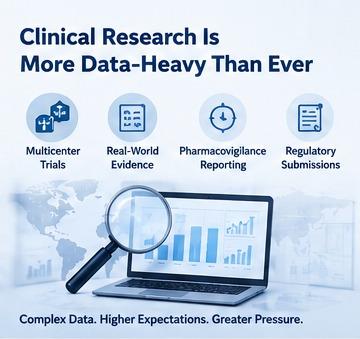
Introduction: Clinical Research Is Becoming More Data-Heavy Than Ever.
The pharmaceutical and life sciences industry is evolving rapidly, and with that evolution comes a massive increase in clinical data. From multicenter clinical trials and real-world evidence studies to pharmacovigilance reporting and regulatory submissions, organizations today are handling enormous volumes of highly complex data. As protocols become more sophisticated and compliance expectations continue to grow, the pressure on biostatistics and programming teams has increased significantly. At the center of this entire process is one critical function: SAS Programming. SAS (Statistical Analysis System) continues to be one of the most trusted platforms in clinical research for clinical trial data analysis, SDTM and ADaM dataset creation, Tables, Listings & Figures (TLFs), regulatory submissions, statistical reporting, and data validation and QC processes.
But while SAS programming is essential, maintaining a fully in-house programming team can become expensive, time-consuming, and difficult to scale. That’s why many pharmaceutical companies, CROs, and biotech firms are now outsourcing SAS programming to specialized partners who can provide faster execution, better flexibility, and cost efficiency.
Outsourcing Is No Longer Just About Saving Money
A few years ago, outsourcing was mostly seen as a way to reduce operational costs. Today, the mindset has changed completely. In modern clinical research, outsourcing SAS programming has become a strategic decision that helps organizations improve efficiency, scale faster, and manage increasingly complex study demands. Outsourcing partners now support a wide range of functions including statistical programming, CDISC implementation, submission support, regulatory compliance, real-time reporting, and advanced analytics workflows. In many cases, outsourced teams work as an extension of internal biostatistics departments rather than external vendors.
Why Managing SAS Programming Internally Becomes Challenging
Building an internal SAS programming setup involves much more than hiring a few programmers. Organizations also need to invest in SAS licensing, infrastructure and validation environments, training and upskilling, compliance systems, talent acquisition, and resource management. Clinical workloads also fluctuate constantly. During major submissions or late-phase trials, programming teams may become overloaded. On the other hand, during slower periods, organizations are left carrying high fixed costs with underutilized resources. This imbalance often affects both timelines and budgets. Outsourcing provides flexibility that internal teams sometimes struggle to achieve.
How Outsourcing SAS Programming Saves Time
1. Faster Access to Skilled Professionals
Hiring experienced SAS programmers—especially professionals with CDISC or submission expertise—can take months. Outsourcing companies already have trained teams with experience in SDTM mapping, ADaM programming, TLF generation, ISS/ISE integration, Oncology studies, and Regulatory submission workflows. This allows projects to start immediately without long recruitment cycles or onboarding delays.
2. Faster Database Lock to Submission Timelines
In clinical research, delays can become extremely expensive. A delay in statistical programming can impact Clinical study reports, NDA submissions, Interim analyses, and Safety reporting timelines. Specialized outsourcing teams often use reusable macros, standardized frameworks, and automated QC workflows that speed up deliverables considerably. This helps organizations move faster from Database Lock → AnalysMany SAS outsourcing providers operate through global delivery centers. This creates near 24/7 operational workflows where teams across different time zones continue programming, validation, and QC activities continuously.
The benefit is faster issue resolution, deliverable completion, review cycles, and project execution, which ultimately accelerates clinical timelines.is → Submission without compromising quality.
3. Ability to Handle Multiple Studies Simultaneously
Internal teams often work with limited bandwidth. Outsourcing creates additional capacity, allowing multiple studies and programming activities to run in parallel. This improves productivity, study turnaround time, portfolio scalability, and resource efficiency without overwhelming internal teams.
4. Global Delivery Models Improve Turnaround
Many SAS outsourcing providers operate through global delivery centers. This creates near 24/7 operational workflows where teams across different time zones continue programming, validation, and QC activities continuously. The benefit is faster issue resolution, deliverable completion, review cycles, and project execution, which ultimately accelerates clinical timelines.
How Outsourcing Helps Reduce Cost
1. Reduced Infrastructure Expenses
Maintaining internal SAS environments requires major investment in Enterprise software licensing, servers and cloud infrastructure, security frameworks, validation systems, and compliance monitoring. Outsourcing providers already operate validated infrastructures, which helps companies avoid large capital expenditures. This converts fixed operational costs into more flexible project-based costs.
2. Lower Hiring and Training Costs
Experienced SAS programmers are highly specialized and in strong demand across the pharmaceutical industry. Recruiting, training, and retaining skilled programmers can become extremely expensive. Outsourcing partners absorb much of that investment internally while providing ready-to-deploy professionals. Organizations save significantly on recruitment, training, certification, and retention costs while still accessing high-level expertise.
3. Flexible Resource Scaling
One of the biggest advantages of outsourcing is scalability. Organizations can increase programming support during peak submissions, reduce resources after project completion, and avoid long-term staffing overhead. This flexibility improves both budget management and operational planning.
4. Reduced Errors and Rework
Experienced SAS outsourcing teams usually follow mature QC and validation processes such as double programming, automated edit checks, standardized macros, and audit-ready documentation. These processes reduce programming errors, submission delays, compliance risks, and costly rework, which directly impacts overall project efficiency.
Automation Is Changing Modern SAS Programming
Modern SAS outsourcing is no longer limited to traditional programming support. Today’s advanced providers increasingly integrate AI-assisted validation, Automated TLF generation, Metadata-driven programming, Cloud-based analytics pipelines, and Risk-based QC frameworks. Automation improves Standardization, Speed, Reproducibility, and Consistency and helps organizations manage increasingly large and complex clinical datasets more efficiently.
Regulatory Compliance Remains a Major Advantage
Clinical data must meet strict regulatory requirements including FDA guidelines, EMA standards, CDISC compliance, GxP requirements, and 21 CFR Part 11 regulations. Experienced outsourcing teams understand these frameworks deeply and ensure deliverables are submission-ready and audit-compliant. This helps organizations reduce regulatory risk while improving confidence in submission quality.
Outsourcing Creates Strategic Value Beyond Cost Savings
While cost reduction is important, the real value of outsourcing lies in operational agility. Organizations gain the ability to focus internal teams on core research activities, accelerate clinical programs, access specialized expertise when needed, scale globally without major infrastructure investments, and improve overall operational flexibility.
In many cases, outsourcing becomes a long-term strategic advantage rather than a temporary operational solution.
The Future of SAS Programming
Clinical research is moving toward more connected, AI-enabled, and data-driven ecosystems. The future of SAS programming will likely include Cloud-integrated statistical computing, AI-supported workflows, Real-time analytics environments, Automated submissions, and Integrated data science platforms. As studies become larger and more complex, organizations will increasingly need scalable programming support models that can adapt quickly to changing research demands.
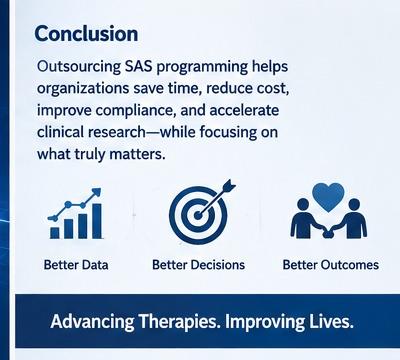
Conclusion
In today’s fast-moving pharmaceutical landscape, organizations need speed, flexibility, scalability, and compliance—all at the same time. Outsourcing SAS programming helps companies reduce operational burden, accelerate clinical timelines, improve submission readiness, access experienced specialists, scale resources efficiently, and maintain high-quality deliverables. More importantly, it allows research teams to focus on what matters most: Advancing therapies, improving patient outcomes, and driving scientific innovation forward.
As clinical research continues becoming more data-intensive and technology-driven, outsourcing SAS programming is evolving from a support function into a key strategic component of modern life sciences operations.