
Introduction
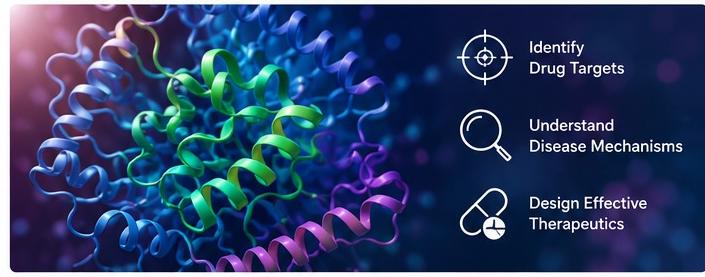
Proteins are the building blocks of life, driving essential biological processes across all living organisms. Understanding their three-dimensional (3D) structure is critical for advancements in drug discovery, biotechnology, and healthcare.
Traditional experimental methods for determining protein structures are expensive and time-consuming. The introduction of AlphaFold by Google DeepMind has transformed this landscape by enabling rapid and highly accurate protein structure prediction.
Why Protein Structure Prediction Matters
The function of a protein is directly determined by its 3D structure. Accurate structural insights allow researchers to:
· Identify potential drug targets
· Understand disease mechanisms
· Design effective therapeutics
However, conventional methods such as X-ray crystallography and cryo-EM are not scalable for the growing number of known proteins, which now exceed 200 million.
What Makes AlphaFold a Breakthrough?
AlphaFold leverages deep learning to predict protein structures from amino acid sequences with remarkable accuracy.
Its performance in CASP14 marked a turning point in computational biology, achieving near-experimental accuracy for many proteins.
Key capabilities include:
· Prediction of novel protein structures without templates
· Rapid processing (minutes instead of years)
· High scalability across millions of proteins
· Built-in confidence scoring for validation
How AlphaFold Works
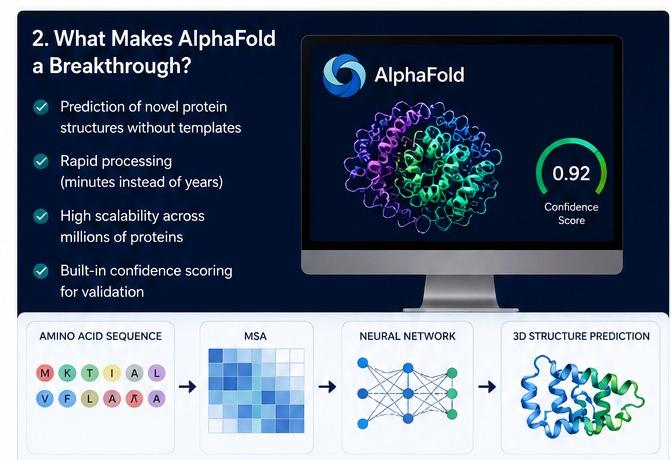
AlphaFold is trained on data from the Protein Data Bank, learning patterns between amino acid sequences and their 3D conformations.
Its architecture combines:
· Multiple Sequence Alignment (MSA) for evolutionary insights
· Attention-based neural networks for residue interactions
· Iterative refinement mechanisms for structural accuracy
Recent advancements like AlphaFold3 extend predictions beyond proteins to include interactions with DNA, RNA, and ligands.
Impact on Scientific Research
AlphaFold has already created a massive impact:
· Predicted 200+ million protein structures
· Enabled open access via the AlphaFold database
· Supported 3+ million researchers across 190+ countries
· Saved millions in research costs and extensive research time
This has democratized access to structural biology data and accelerated innovation globally.
AlphaFold in Drug Discovery: Opportunities and Challenges
AlphaFold is a powerful tool in structure-based drug discovery, enabling:
· Faster identification of therapeutic targets
· Enhanced protein-ligand interaction studies
· Accelerated early-stage drug development
However, studies show that AlphaFold models may underperform in high-throughput docking (HTD) compared to experimentally derived structures.
Key considerations:
· Post-model refinement is often required
· Experimental validation remains essential
· Hybrid AI + experimental approaches yield optimal results
Future Outlook
AlphaFold represents a paradigm shift but also highlights areas for future improvement:
· Better modelling of dynamic protein behaviour
· Improved docking compatibility
· Integration with end-to-end drug discovery pipelines
As AI continues to evolve, tools like AlphaFold will play a central role in precision medicine and next-generation therapeutics.
Conclusion
AlphaFold has redefined what is possible in protein structure prediction, significantly accelerating biological research and drug discovery. For companies like Texium Solutions, integrating such AI-driven innovations can unlock new opportunities in bioinformatics, healthcare analytics, and pharmaceutical research.