
Introduction: The Data Bottleneck in Modern Life Sciences
In today’s hyper-connected scientific ecosystem, laboratories generate petabytes of high-dimensional, heterogeneous data—from chromatography outputs to multi-omics datasets. Yet, the real challenge isn’t data generation—it’s data interoperability, contextualization, and usability. Despite advancements in AI and computational biology, most organizations still struggle with data silos, inconsistent formats, and lack of semantic standardization. This is precisely where frameworks like the Allotrope Foundation step in—reshaping how scientific data is structured, shared, and analyzed. For companies like Texium Solutions, operating at the intersection of AI, scientific informatics, and life sciences, Allotrope is not just a standard—it’s a strategic enabler of digital transformation.
The Allotrope Foundation is a global consortium of pharmaceutical leaders, technology providers, and research institutions focused on standardizing laboratory data across its entire lifecycle. Its mission is simple yet transformative: create a universal, machine-readable, and semantically rich data ecosystem for scientific workflows. At the core of this ecosystem lies the Allotrope Framework, which integrates the Allotrope Data Format (ADF), a scalable, platform-agnostic format for storing complex experimental data; Allotrope Data Models (ADM), structured schemas defining how data should be represented; and Allotrope Foundation Ontologies (AFO), a controlled vocabulary enabling semantic consistency. Together, these components create a FAIR-compliant data architecture (Findable, Accessible, Interoperable, Reusable), enabling seamless data exchange across systems and organizations.
Deep Dive: The Allotrope Data Format (ADF)
The ADF is the backbone of the Allotrope ecosystem—designed to handle multi-dimensional, high-throughput experimental data. Key capabilities include storage of n-dimensional data arrays (data cubes) for time-series and analytical outputs, integration of rich metadata including instrument configurations and experimental conditions, a foundation built on HDF5 architecture enabling scalability and high-performance data access, and support for linked data principles that connect datasets with contextual scientific knowledge. This allows organizations to store entire experiments—raw data, processed outputs, and metadata—within a single, portable file.
The Allotrope Simple Model (ASM): Simplifying Complexity
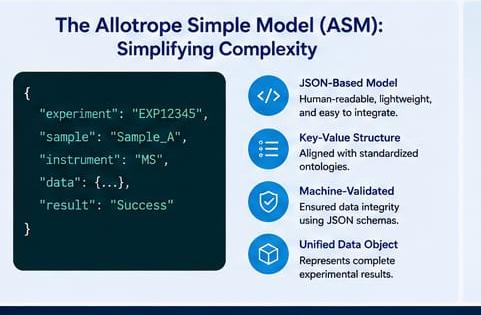
While ADF handles complex data structures, the Allotrope Simple Model (ASM) focuses on accessibility and usability. ASM is a JSON-based data model, optimized for readability and interoperability. It is structured using key-value pairs aligned with standardized ontologies, designed to represent complete experimental results as unified data objects, and fully machine-validated using JSON schemas, ensuring data integrity. This enables scientists and engineers to work with human-readable yet machine-actionable datasets, eliminating the friction between data generation and analysis.
Why Allotrope Matters: From Data Chaos to Data Intelligence
Traditional lab environments rely heavily on instrument-specific formats and fragmented data pipelines, leading to loss of contextual metadata, limited reproducibility, high manual intervention, and inefficient AI model training. The Allotrope framework addresses these challenges by enabling semantic interoperability, where standardized ontologies ensure that data from different instruments and domains can be understood uniformly across systems. It also enhances data integrity and compliance through built-in validation and structured metadata that improve traceability, auditability, and regulatory compliance. Additionally, the framework supports AI-readiness, as structured and standardized data is inherently AI/ML-friendly, accelerating model development and deployment. From acquisition to archival, the Allotrope framework enables end-to-end data lifecycle management, ensuring that data remains consistent, accessible, and reusable.
Texium Solutions: Bridging Allotrope with AI-Driven Scientific Informatics
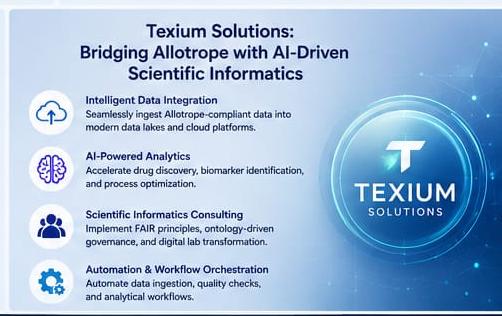
At Texium Solutions, the integration of frameworks like Allotrope aligns directly with its core mission—leveraging AI to transform life sciences data into actionable intelligence. Texium Solutions creates impact through intelligent data integration by enabling seamless ingestion of Allotrope-compliant datasets into modern data lakes and cloud-native architectures, ensuring cross-platform interoperability. texium also drives AI-powered analytics by working with standardized, semantically enriched data, accelerating predictive modeling in drug discovery, biomarker identification, and process optimization in biomanufacturing. In addition, Texium provides scientific informatics consulting to implement FAIR data principles, ontology-driven data governance, and end-to-end digital lab transformation.
Furthermore, using Allotrope’s structured data pipelines, Texium helps automate data ingestion, quality checks, and analytical workflows through automation and workflow orchestration.
The Future: Converging AI, Ontologies, and Scientific Data Standards
The convergence of Allotrope standards, AI, and cloud computing is redefining the scientific landscape. We are moving toward a future where experiments are fully digitized and reproducible, data is self-describing and machine-interpretable, AI models are trained on high-quality, standardized datasets, and decision-making is driven by real-time, integrated insights. This is not just digital transformation—it’s scientific intelligence at scale.
Conclusion: From Data to Discovery
The Allotrope ecosystem represents a foundational shift in how scientific data is structured and leveraged. By eliminating fragmentation and enabling semantic consistency, it unlocks the full potential of AI-driven research and innovation. For organizations embracing digital transformation, the question is no longer whether to adopt standards like Allotrope—but how fast they can integrate them. And that’s where Texium Solutions stands at the forefront—turning complex scientific data into meaningful, AI-powered outcomes.