
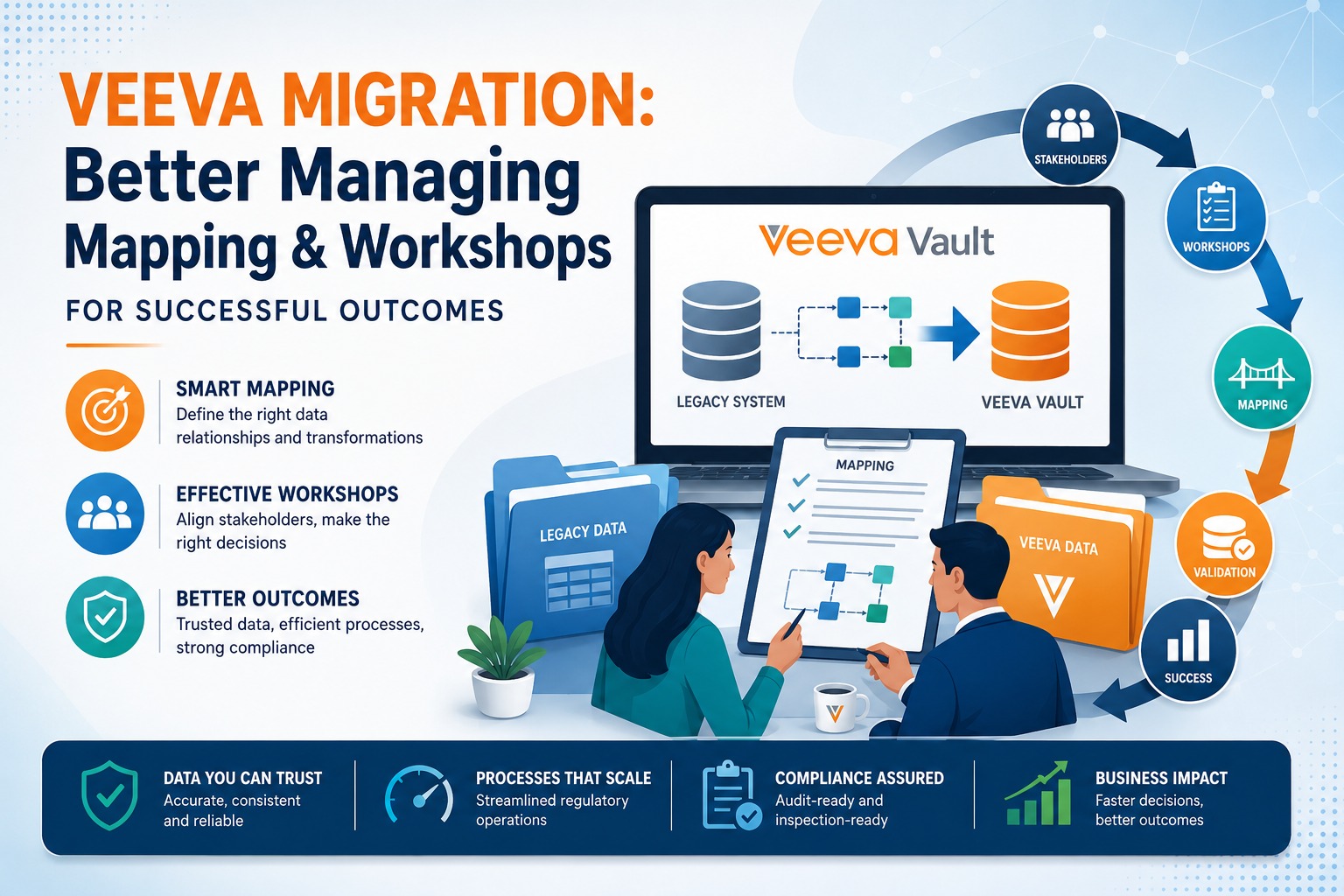
Migrating to Veeva Vault—especially across RIM, Clinical, or Quality domains—is not just a technical exercise. The real success lies in how well you manage data mapping and how effectively you run your workshops. Most migration failures don’t happen because of tools—they happen because of Poor mapping decisions
Misaligned stakeholder workshops This blog gives you a step-by-step, execution-level guide to mastering mapping and workshop strategy during Veeva migration.
Why Mapping & Workshops Are the Backbone of Veeva Migration
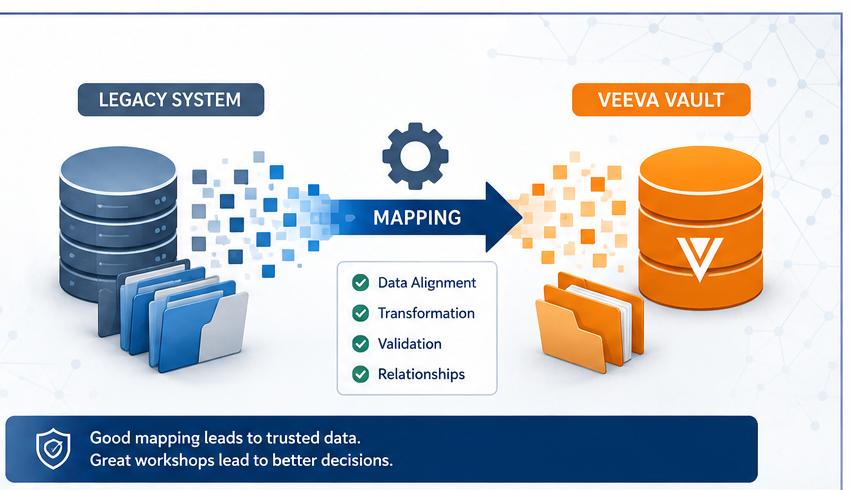
Before diving into execution, it’s important to understand
. Mapping defines HOW your legacy data behaves in Veeva
. Workshops define WHAT decisions are made and Why
If either fails:
Your system becomes unusable
Users lose trust
Rework increases exponentially
Step 1: Define a Mapping Strategy (Before Any Workshop Begins)
1.1 Understand the Target Data Model
Start with a deep dive into the Veeva Vault structure:
Objects (e.g. Registrations, Submissions)
Fields and relationships
Controlled vocabularies
Don’t try to replicate legacy systems—align with Veeva’s standard model.
1.2 Classify Data for Migration
Segment your data into:
Category
Approach
Active regulatory data
Migrate with full fidelity
Historical data
Archive or partial migration
Redundant/obsolete
Eliminate
This reduces mapping complexity by 30–50% in most programs.
1.3 Define Mapping Principles
Set clear rules early:
One source of truth per data element
Avoid duplicate mappings
Prefer standard fields over custom fields
Maintain referential integrity
Example: Legacy: Multiple product names →
Vault: Single standardized product object
Step 2: Prepare for Mapping Workshops
Mapping workshops are where most critical decisions happen.
2.1 Identify the Right Stakeholders Include:
Regulatory SMEs
Business process owners
Data stewards
Technical architects
Avoid workshops with only IT—this leads to technically correct but business-invalid mapping.
2.2 Pre-Workshop Preparation (Critical Step)
Before the session:
Extract sample legacy data
Create initial draft mappings (70% ready)
Identify data anomalies
Never start workshops from scratch—you’ll waste time and lose direction.
2.3 Define Workshop Objectives Clearly
Each workshop must answer:
What data are we mapping?
What decisions are required?
What outputs are expected?
Example objective-“Finalize mapping for Submission and Application objects including relationships”
Step 3: Execute High-Impact Mapping Workshops
3.1 Follow a Structured Workshop Flow
Phase 1: Context Setting
Explain business process
Show current vs future state
Align on terminology
Phase 2: Field-Level Mapping
For each field:
Source field
Target field
Transformation logic
Mandatory vs optional
Example: Legacy Field: “Country Code”
Vault Field: “Market”
Transformation: ISO standard alignment
3.3 Resolve Data Conflicts in Real-Time
👉Common issues:
Duplicate records
Missing values
Conflicting definitions
👉 Use decision frameworks:
Business rule override
Data hierarchy
Default values
3.4 Capture Decisions Rigorously
Every workshop must produce:
Final mapping sheet
Transformation rules
Open issues log
👉 If it’s not documented, it’s not decided.
Step 4: Optimize Mapping Design
4.1 Focus on Relationships (Most Critical Area)
In Veeva Vault:
Product ↔ Submission
Submission ↔ Document
Registration ↔ Market
👉 Poor relationship mapping = broken regulatory insights
4.2 Handle Controlled Vocabularies Carefully
Align legacy values to Veeva picklists
Standardize naming conventions
👉 Example:
“USA”, “US”, “United States” → “United States”
4.3 Design Transformation Logic
Types of transformations:
Direct mapping
Lookup-based mapping
Derived values
👉 Example:
Combine fields → Submission identifier
Step 5: Validate Through Mock Migrations
5.1 Run Iterative Test Cycles
Load sample data into sandbox
Validate with business users
5.2 Perform Data Reconciliation Check:
Record counts
Field accuracy
Relationship integrity
👉 This ensures data trust before go-live.
5.3 Capture Feedback and Refine
Update mappings
Adjust transformation logic
Fix edge cases
Step 6: Governance & Change Control
6.1 Establish Mapping Governance
Version-controlled mapping documents
Approval workflows
Change tracking
6.2 Avoid Scope Creep Common risk:
“Let’s add this field—it might be useful”
👉 Every addition increases:
Complexity
Testing effort
Migration risk
Step 7: Post-Migration Optimization
Even after go-live:
7.1 Monitor Data Quality
Missing values
Incorrect mappings
User feedback
7.2 Continuous Improvement
Refine picklists
Optimize workflows
Enhance reporting
Common Pitfalls in Mapping & Workshops
. Starting workshops without preparation
. Treating mapping as a technical activity only
. Ignoring data relationships
. Over-customizing Veeva Vault
. Lack of documentation
Key Success Factors
. Business-led workshops
. Pre-defined mapping strategy
. Strong data governance
. Iterative testing approach
. Alignment with Veeva standards
Conclusion: Mapping is the Heart of Migration
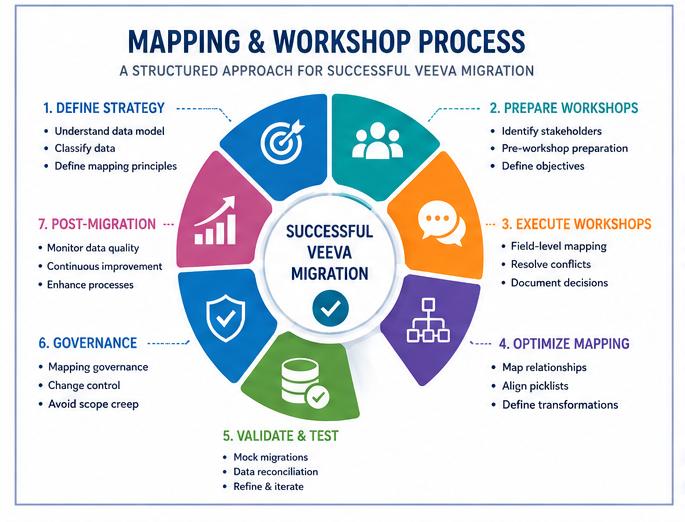
A successful Veeva migration is not about moving data—it’s about making data meaningful.
When mapping and workshops are done right:
Users trust the system
Regulatory processes accelerate
Compliance improves
When done wrong:
You create a digital version of your legacy chaos
The difference lies in discipline, structure, and collaboration.